
After trying OpenFate’s Bazi, astrology and Tarot tools, I would recommend it to readers who enjoy these traditions and want room to ask questions. What stayed with me was a Tarot suggestion: write for fifteen minutes, or draft two paragraphs. It fitted the question I had asked.
My OpenFate review comes down to that combination: detailed readings to explore, and smaller ideas to take away.
My verdict: Worth trying for detailed chart readings and thoughtful Tarot prompts.
My experience score: 8.6/10, based on the five equally weighted criteria below.
Best for: Curious beginners and regular readers who want Bazi, astrology and Tarot in one account.
Less suitable for: Anyone seeking guaranteed predictions or advice to replace a qualified professional.
What I used: Two full reports, one Bazi follow-up and one three-card Tarot interpretation. The account used 140 credits.
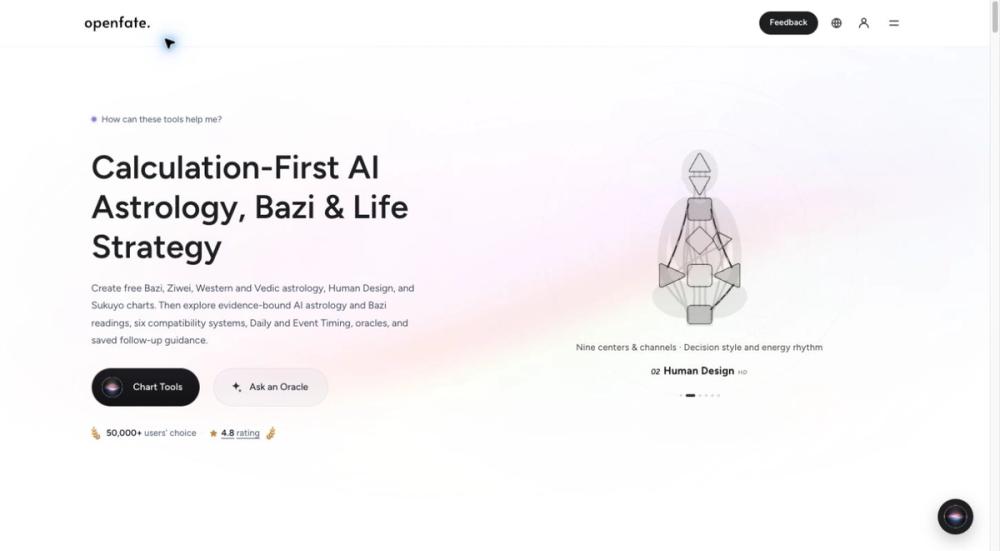
The homepage brings the different reading tools together.
OpenFate at a glance
OpenFate worked well for exploring several reading traditions without starting over each time. I could reuse a saved profile, read a report and return to the results through the same account.
- Tools I used: Bazi, Western astrology and three-card Tarot
- Access: Pro Max prepaid access
- Interface: English, on desktop
- Completed readings: Two full reports and one Tarot interpretation
- Additional conversation: One Bazi follow-up
- Credit balance: 400 at the start; 260 after use
- Entry price I saw: US$6.99 for 250 non-expiring credits
How I used OpenFate
I completed the readings, reopened a saved result and checked the charges. This gave me a picture of the experience from setup to revisiting an answer.
I used one saved birth profile for the two chart tools. My focus was on entering information, navigating the reports and asking for clarification; I left the optional career, relationship and health background fields empty.
- I saved a profile and generated a Bazi report.
- I switched between its Report and Chart views and opened the calculation receipt.
- I asked one follow-up about the basis for parts of the interpretation.
- I reused the profile for astrology, retried an unsuccessful generation and read the completed report.
- I entered a writing question in Tarot, selected three cards and requested their interpretation.
- I checked the credit ledger and reopened the Tarot reading from history.
1. Bazi: I could look beyond the written interpretation
I liked being able to inspect the chart information alongside the Bazi report. The calculation receipt gave me a place to check the settings behind the reading.
I started with OpenFate’s Bazi reading. After generating the report, I moved between the written explanation and the Chart view, then opened the receipt to inspect the time handling and chart conventions.
That matters when a report introduces unfamiliar ideas. Rather than reading the whole text in one pass, I could look at a chart detail and return to the relevant explanation. The report included sections on strengths, relationships, work and longer-term themes, with tables that helped me browse.
As a beginner, I would read one section and ask about unfamiliar terms before moving on. Some English-interface labels remain in Chinese, which adds a learning step. Having the chart and explanation together gave me a clear starting point.
2. Astrology: the overview made a long report approachable
The astrology report was easier to read because it began with a short overview. I could get oriented, then choose the topic I wanted to explore.
I opened OpenFate’s astrology tool and reused the saved profile. This saved another round of entering birth details and made moving from Bazi to astrology straightforward.
The Report at a glance section outlined a central pattern, a growth focus and a suggested next move. Its topic shortcuts gave me a way into relationships, work and practical guidance without reading every section in sequence.
I also inspected the wheel, placement information and aspect network. I followed an aspect mentioned in the text back to the chart, which helped me understand what the explanation referred to. For me, that connection was more useful than a long report on its own.
One generation did not complete. The inputs remained available, and my retry succeeded without rebuilding the profile.
3. Tarot: the part I would recommend trying first
Tarot gave me the clearest practical takeaway from OpenFate. The answer stayed close to the writing question I entered and offered manageable ideas to consider.
I used OpenFate’s three-card Tarot reading with this question:
For a small creative writing project, what should I focus on this month to make steady progress without overcommitting?
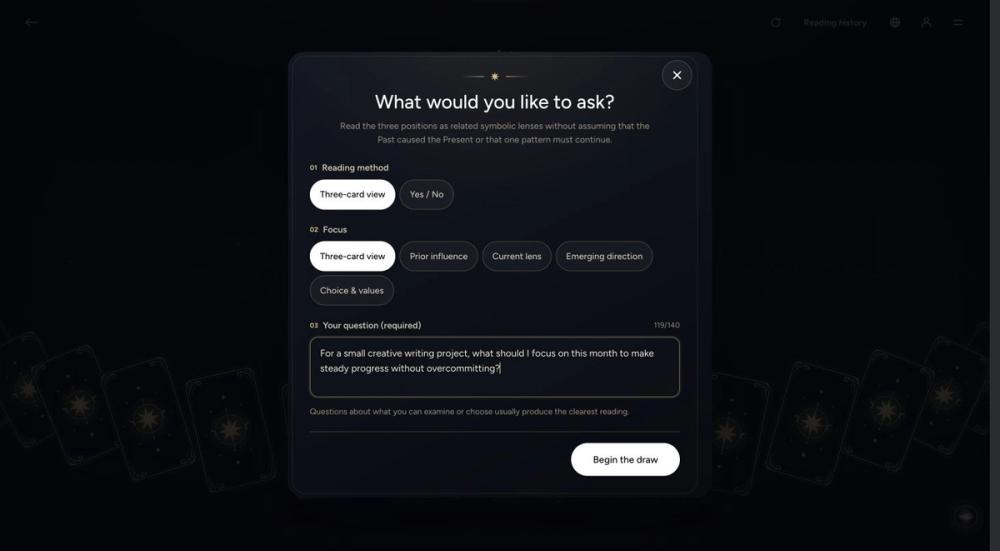
I chose a focused question about progress and workload.
The question gave me a clear standard: did the answer address steady progress without encouraging an unrealistic commitment?
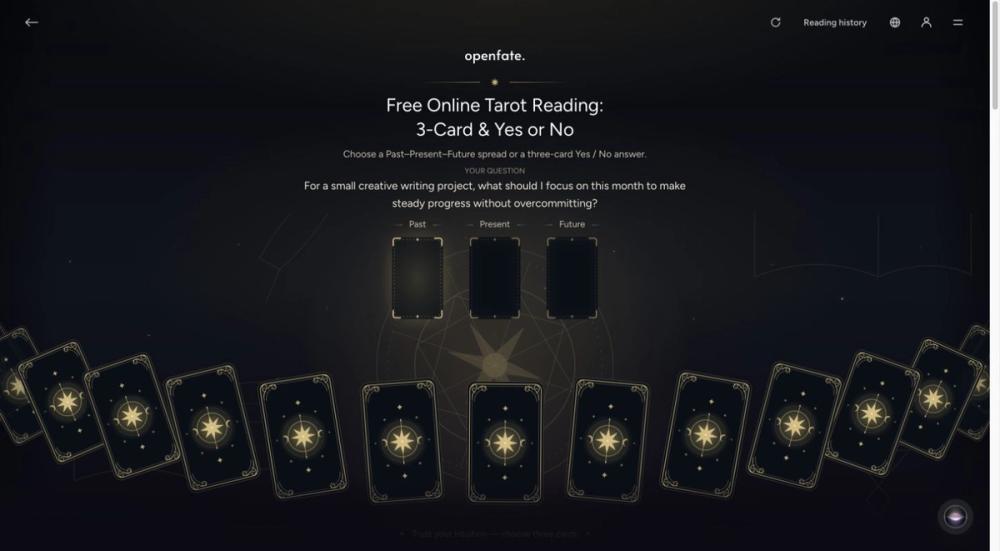
The selection screen before I revealed the cards.
The first completed draw gave me Six of Swords reversed for the Past, Page of Pentacles reversed for the Present and King of Cups upright for the Future. I kept this draw and requested its interpretation.
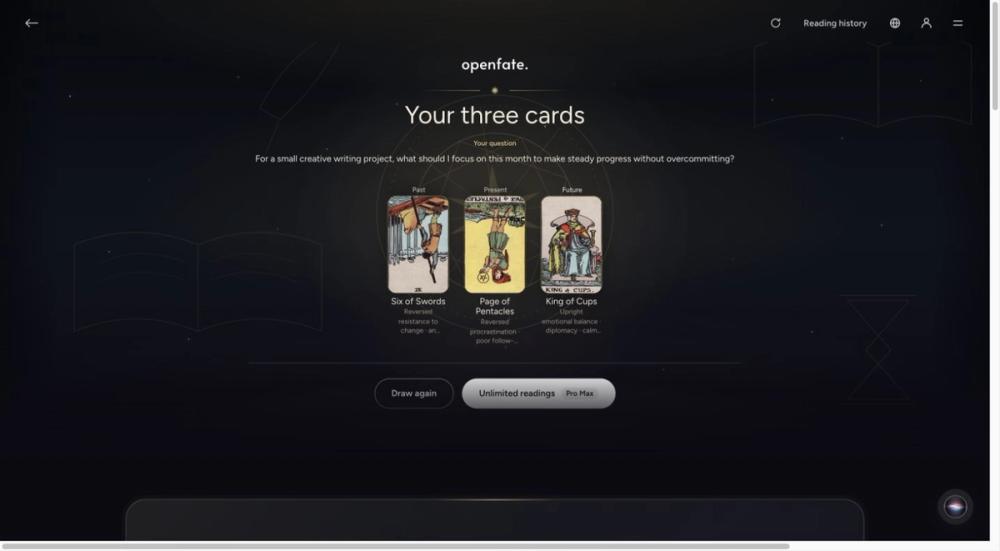
The names, positions, orientations and keywords were visible before the interpretation.
Seeing the cards first made the reading easy to follow. I could read each card’s keywords, then see how the longer answer connected them to the question.
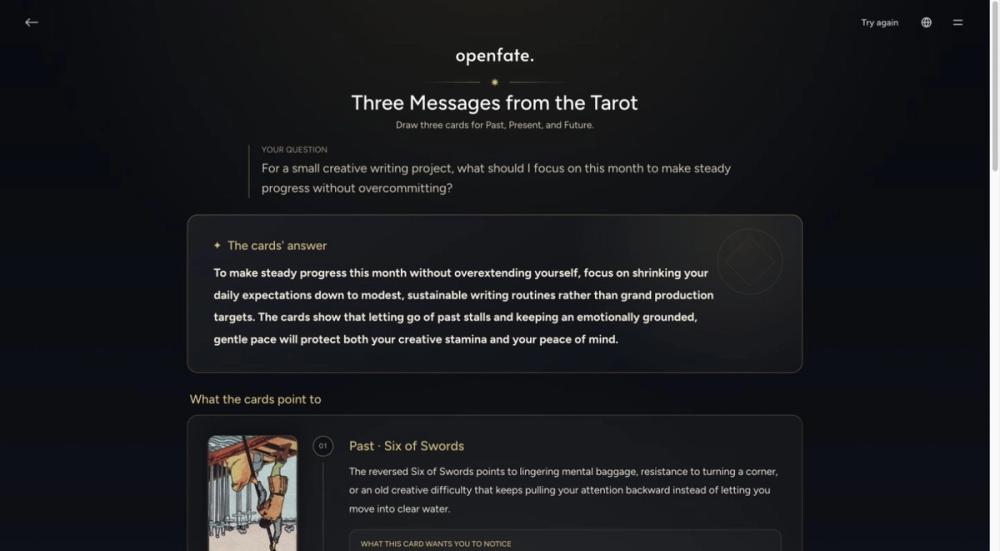
The interpretation develops the reading card by card.
The suggestion that stood out was to set a small baseline: fifteen minutes or two paragraphs. The reading also suggested separating drafting from evaluation, choosing small milestones and protecting enough energy to keep a routine sustainable.
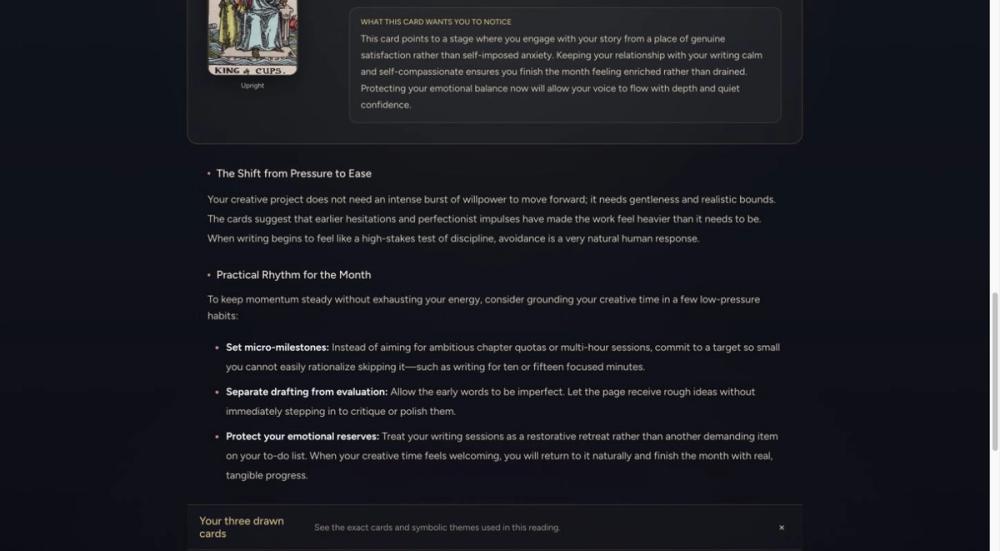
The practical advice collects the suggested habits in one section.
I found that scale sensible. A small writing target and separate drafting and editing sessions are easy to understand. These were suggestions from the reading; I have not measured their effect over a month.
I would start here if you are curious: bring one everyday question and see whether the interpretation gives you a useful perspective.
4. Follow-up questions helped me get a more careful answer
The Bazi follow-up was useful when I wanted clarification rather than more text. It let me question specific claims and get an explicit correction.
The initial report included work and health assumptions even though I had left the background fields empty. I asked it to distinguish chart information, traditional interpretation and unsupported personal claims.
The response withdrew the unsupported assertions and offered reflection questions instead. I appreciated getting a direct answer to the concern, although the original wording should have been more careful.
I would use the conversation feature again to ask what supports a passage or have a term explained. My follow-up cost 10 credits and helped me examine wording that sounded too specific.
5. Saved results and credit records made the account useful
I could return to the completed Tarot reading without drawing again. I could also see exactly how many credits the reports and follow-up had used.
My Records showed two reports, one oracle reading and one chat. I opened the saved Tarot result from history, which is useful if you want to find a passage again after reading other material.
The balance started at 400 credits and ended at 260. Here is the breakdown I checked:
- Bazi full report: 65 credits
- Astrology full report: 65 credits
- Bazi follow-up: 10 credits
- Tarot interpretation with my Pro Max access: No additional deduction shown
- Total: 140 credits
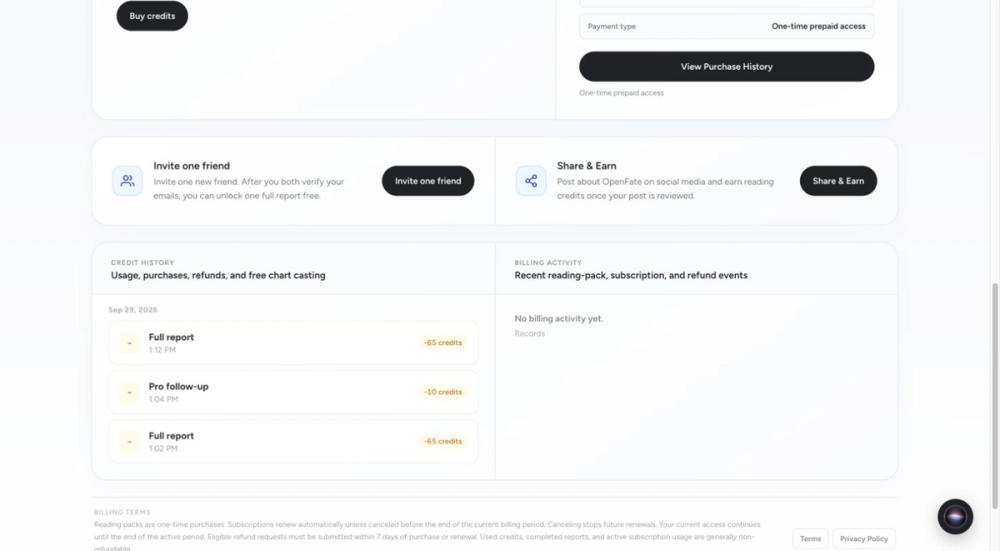
The ledger shows the three deductions behind the 140-credit total.
The failed astrology attempt did not produce an extra deduction in the final ledger. My Tarot reading used the Pro Max oracle allowance, so its cost here should not be treated as the price for every account.
OpenFate review score: why I give it 8.6/10
My overall experience score is 8.6/10. The strongest parts were profile reuse, readable reports and Tarot advice that addressed the question I supplied.
I give each of the following five criteria equal weight. On my scale, 9 means a strong experience with little friction; 8 means useful overall with a specific drawback; 10 would mean no meaningful reservation within the scope I used.
- Setup and profile reuse — 9/10: I used the saved profile across both chart tools.
- Chart access and report navigation — 9/10: I inspected chart information and could browse reports by topic.
- Relevance of the Tarot advice — 9/10: The writing suggestions addressed progress without overcommitting.
- Interpretation and clarification — 8/10: The Bazi follow-up corrected unsupported initial assumptions.
- Completion and account records — 8/10: A retry was needed; saved results and the credit ledger worked.
- Average — 8.6/10: (9 + 9 + 9 + 8 + 8) ÷ 5.
This is my subjective assessment of the experience, rather than a measurement of prediction accuracy.
What I liked most
- Reusing a profile made a second chart easier to start.
- Chart views and report summaries gave me a way into detailed material.
- Tarot offered small, understandable suggestions.
- Follow-up questions let me examine an interpretation more closely.
- Saved readings and credit history were easy to revisit.
What could be better
- The Bazi report initially made personal assumptions I had not supplied.
- Astrology required one retry before the report completed.
- Some Bazi terms need explanation for an English-speaking beginner.
Which reading would I choose first?
I would choose Tarot for a focused question and a chart report for a longer exploration. The best starting point depends on the kind of reading you enjoy.
- Bazi: Exploring a traditional chart and its themes. Prepare accurate birth information and time to learn some terms.
- Astrology: A visual chart with topic-based explanations. Prepare accurate birth information and a topic of interest.
- Three-card Tarot: Reflecting on an everyday question. Prepare one clear question with a manageable scope.
Tarot has the simplest starting point of the three I used. For Bazi or astrology readers, detailed reports and profile reuse may matter more.
Pricing: what I would choose for occasional use
I would start with a small one-time credit pack for occasional chart readings. A subscription deserves consideration when you expect to use the tools regularly.
These are the USD prices I saw while using the product:
- One-time pack — US$6.99: 250 non-expiring credits.
- One-time pack — US$11.99: 500 non-expiring credits.
- One-time pack — US$19.99: 1,000 non-expiring credits.
- Pro, monthly — US$26.99/month: 200 daily credits.
- Pro Max, monthly — US$49.99/month: 400 daily credits and unlimited AI readings across six oracles.
The two reports and one follow-up I completed used 140 credits. That is a useful reference for similar chart use, although other readings can have different costs and allowances.
My account already had prepaid access; I did not purchase or renew a monthly plan. Check the latest prices and terms before buying. For frequent Tarot use, I would compare oracle allowances; for occasional reports, I would prioritize non-expiring credits.
My final recommendation: is OpenFate worth it?
My answer after this OpenFate review is yes, for readers who want an accessible way to explore Bazi, astrology and Tarot. I enjoyed having detailed reports, follow-up questions and saved results together.
The Tarot reading gives the clearest example of why I would recommend trying it. I asked about steady progress on a writing project and received suggestions small enough to consider applying. The chart reports offered a deeper reading experience when I wanted more material to explore.
I would recommend it to curious beginners willing to learn a few terms, and to readers who already enjoy these traditions. I would use the interpretations for reflection while keeping health, financial and other important decisions grounded in real-world information and professional advice.
My suggested first visit is simple:
- Choose the reading that interests you most.
- Enter accurate birth details or one focused Tarot question.
- Read the chart or cards alongside the explanation.
- Ask about any passage that needs clarification.
- Choose paid access according to how often you expect to return.
OpenFate FAQ
I would choose paid access according to reading style, frequency of use and allowance. These are the main questions to check.
Is OpenFate worth it?
I would recommend trying it for detailed chart reports and focused Tarot reflection. The organized reports, follow-up option and saved results were the main reasons I found it worthwhile.
How much does OpenFate cost?
I saw one-time packs at US$6.99, $11.99 and $19.99, and monthly Pro and Pro Max plans at $26.99 and $49.99. Check current pricing before buying.
What are OpenFate’s main pros and cons?
I liked profile reuse, report navigation, practical Tarot suggestions and saved readings. The main drawbacks were unsupported assumptions in the initial Bazi text and one astrology generation that needed a retry.
Can I try OpenFate for free?
The Tarot page describes free card draws and a first successful AI oracle reading after sign-in, shared across six oracles. I used Pro Max access, so I did not separately test that free allowance.
Is OpenFate accurate enough for important decisions?
I did not measure predictive accuracy. I would use it to explore questions, while relying on evidence and qualified advice for important decisions. Review its privacy settings before entering sensitive information.
What alternatives should I consider?
A dedicated chart calculator may suit you if you mainly want chart data; a human reader may suit you if conversation matters most. I would choose according to the reading style I want: chart data, a written interpretation or a conversation.
__